Crime and Punishment in Ancient Rome by Richard A.bauman
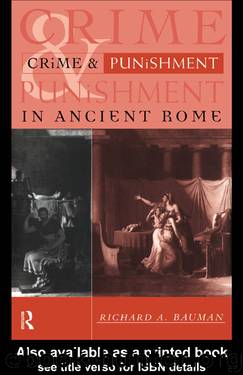
Author:Richard A.bauman [A.bauman, Richard]
Language: eng
Format: epub
Tags: Humanities
ISBN: 041511375X
Publisher: Taylor & Francis
Published: 2007-06-11T00:00:00+00:00
CRIMINAL JURISPRUDENCE: DE IUDICIIS PUBLICIS
MOTIVATION AND IDEOLOGY
What prompted the sudden upsurge of interest in the criminal law in the Antonine period? The question can no doubt be approached through general evaluations of how the jurists thought in the second century,27 but something more specific is needed. The best attempt so far made to provide it is that recently undertaken by Fanizza.28 The thrust of her argument is that Maecian and Venuleius set out to mould Augustus’
criminal legislation29 into a harmonious system capable of regulating criminal repression right across the board. Although still anchored in the jury-courts, they also took account of the fragmentary, and still fluid, cognitio extra ordinem. But the leges remained the frame of reference for the latter as much as for the quaestiones. In the wake of Hadrian’s reforms the problem for the jurists was to reconcile the statutory rules with the regulations evolved by cognitio. The jurists were motivated by the ideology of Antoninus Pius’ reign. That ideology included familiarity with the advanced cultural levels of the day; specialized expertise; and recognition of the distinctions between honestiores and humiliores that were starting to be entrenched in the system.
One part of Fanizza’s thesis can be accepted right away. The leges continued to supply the frame of reference, and the link was more than nominal. At the turn of the third century, for example, Pauli Sententiae quoted numerous definitions of crimes taken verbatim from leges.30 The same work shows, perhaps more coherently than any other source, just how interpretation had produced changes in scope and emphasis.31
Sometimes it does more. It tells us, for example, that if someone is killed by a branch that was thrown down without a warning, the culprit is sent to the mines etsi in legem non incurrit, ‘even though it does not fall under the lex (de sicariis)’.32 The basis of liability is thus negligence. But it is not a crimen extraordinarium as such; Sententiae locates it under the rubric Ad legem Corneliam de sicariis et veneficis. On the other hand, it is not an extension of anything in the lex de sicariis. The basis of that statute was doing something with a specific intent—walking around with a weapon etc.—and if, as here, it was done negligently it cannot be interpreted into the lex. But it is close enough to the end result of the lex, causing death, to be loosely associated with it.
Now, the example that we have just cited comes from an early post-classical work, when the task of harmonizing the old and the new had (presumably) been completed. It does not follow that the same degree of harmonization had been achieved by the Antonines. Fanizza is, I think, aware of this, for in her final chapter she narrows down her hypothesis: it 119
Download
This site does not store any files on its server. We only index and link to content provided by other sites. Please contact the content providers to delete copyright contents if any and email us, we'll remove relevant links or contents immediately.
The Vikings: Conquering England, France, and Ireland by Wernick Robert(84385)
Ali Pasha, Lion of Ioannina by Eugenia Russell & Eugenia Russell(40322)
The Conquerors (The Winning of America Series Book 3) by Eckert Allan W(37991)
The Vikings: Discoverers of a New World by Wernick Robert(37008)
Cecilia; Or, Memoirs of an Heiress — Volume 1 by Fanny Burney(32640)
Cecilia; Or, Memoirs of an Heiress — Volume 2 by Fanny Burney(32014)
Cecilia; Or, Memoirs of an Heiress — Volume 3 by Fanny Burney(31999)
Empire of the Sikhs by Patwant Singh(23140)
The Secret History by Donna Tartt(19317)
Hans Sturm: A Soldier's Odyssey on the Eastern Front by Gordon Williamson(18653)
Cat's cradle by Kurt Vonnegut(15447)
Pimp by Iceberg Slim(14690)
Sapiens: A Brief History of Humankind by Yuval Noah Harari(14469)
Norse Mythology by Gaiman Neil(13460)
Talking to Strangers by Malcolm Gladwell(13449)
Leonardo da Vinci by Walter Isaacson(13414)
4 3 2 1: A Novel by Paul Auster(12524)
Underground: A Human History of the Worlds Beneath Our Feet by Will Hunt(12150)
The Radium Girls by Kate Moore(12097)
